What a useful AI pilot looks like
A good pilot is small, time-boxed, and tied to a number you already track. We share the one-page brief we use to keep pilots honest — and the exit criteria that let you stop one without it feeling like failure.
Most AI pilots fail in the same quiet way: they never really begin and they never really end. They start as an open-ended “let’s experiment with this” and drift until everyone loses interest, with no clear sense of whether the thing worked. The experiment was real. The honesty was missing.
A useful pilot is the opposite. It’s small, it’s time-boxed, and it’s tied to a number you already track. You know what you’re testing, you know when you’ll have an answer, and you know in advance what would make you stop. Here’s what that looks like in practice — and the one-page brief we use to keep it honest.
A pilot is a question, not a project
The first reframe is the most important one. A pilot isn’t a small version of a rollout. It’s a way to answer a specific question cheaply before you commit. The question is usually some version of: does AI actually move this number for us, on our real work, enough to be worth it?
If you can’t state the question in a sentence, you don’t have a pilot — you have an open-ended experiment that will quietly expand until it collapses under its own weight. So write the question down first. “Can we get first-draft support replies out in under an hour without dropping quality?” is a question. “Let’s see what AI can do for support” is not.
The one-page brief
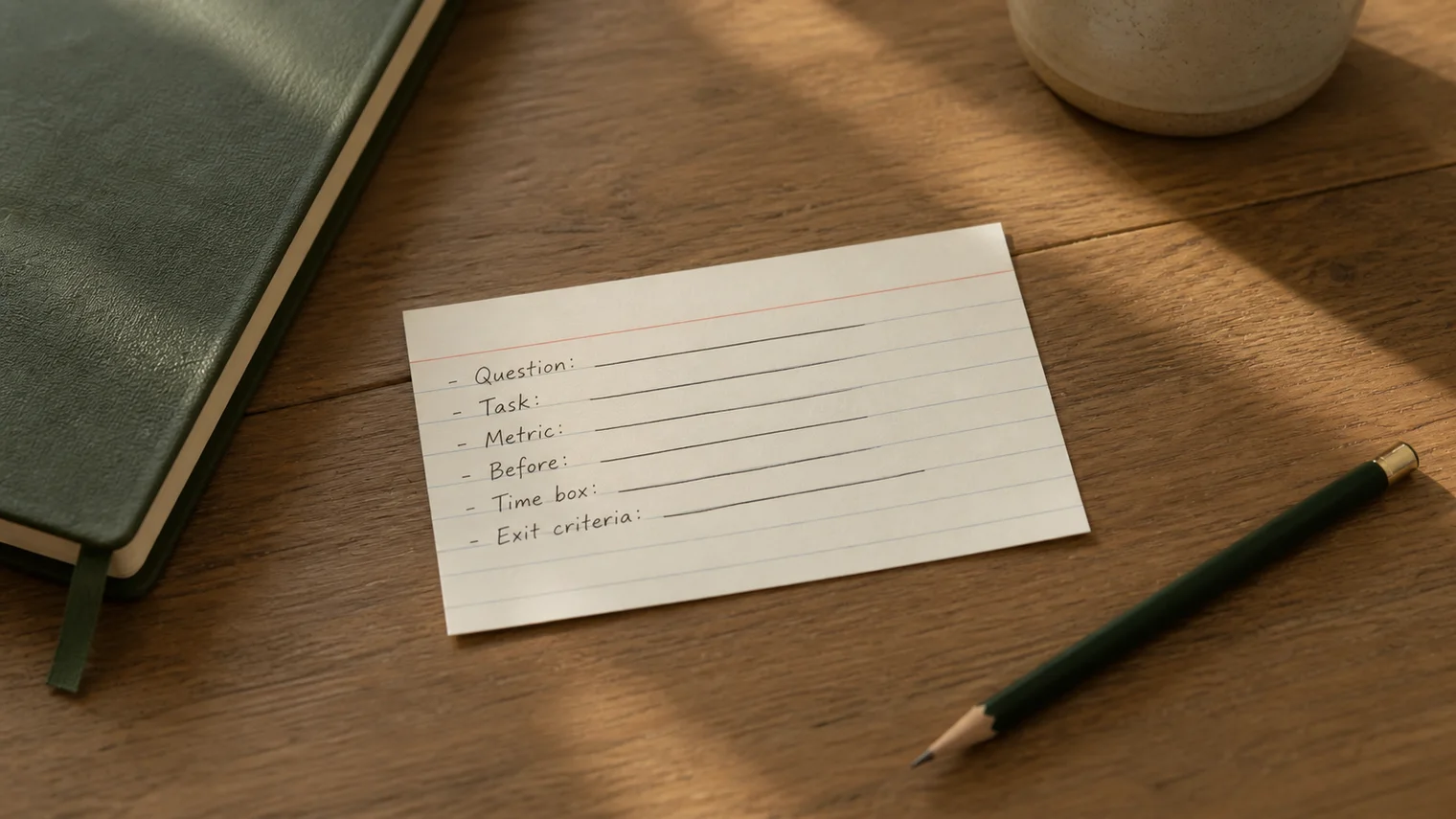
Everything you need to run a pilot honestly fits on a single page. If it takes more than that, the pilot is too big. Ours has six lines:
- The question. The one thing you’re trying to learn, in a sentence.
- The one task. A single, specific, frequent, same-shaped task — not a category of work.
- The number. One metric you already track that should move if this works. Hours per week, replies before lunch, errors caught, days-to-quote. One, not five.
- The before. That number’s honest current value, measured — not remembered — before you start.
- The time box. How long the pilot runs before you decide. Usually one to three weeks. Long enough for a real signal, short enough that stopping costs little.
- The exit criteria. What result means keep going, and what result means stop.
That’s the whole brief. Notice what’s not on it: no roadmap, no transformation goals, no list of everything AI might eventually do. A pilot earns the right to think bigger by first answering one small question well.
Run the new way next to the old way
During the pilot, keep doing the work the old way too. Run the AI version alongside it rather than ripping out what works and hoping. This does two things: it protects you if the pilot flops, and it gives you a clean comparison — same task, same week, old way versus new way, measured against the same number.
It also keeps a human in the loop where it belongs. Early on, a person should be checking the output before it goes anywhere. The system handles the routine and flags anything it isn’t sure about for review. You’re not testing whether you can remove people yet; you’re testing whether the assisted version is genuinely faster and at least as good. That’s a lower bar and a far more useful one.
Exit criteria are what make it honest
Here’s the part almost everyone skips, and it’s the part that makes a pilot trustworthy: decide before you start what would make you stop.
A pilot you’re allowed to stop is a pilot you can run honestly. Without exit criteria, every result gets rationalized — a bad outcome becomes “we just need more time,” and a mediocre one becomes “well, it’s kind of working.” With them, the pilot reports a clear answer.
Write down both directions. What does success look like — the number moved by this much, with quality holding? And what does “stop” look like — the number didn’t move, or quality slipped, or it took more babysitting than it saved? If you hit the stop condition, you stop. That’s not the pilot failing. That’s the pilot doing its only job: telling you the truth cheaply, before you spent real money finding out the hard way.
We say this to clients often: a pilot you can stop without anyone feeling bad is a pilot worth running. The whole point is to make “no” a perfectly good outcome.
Small, honest, and over quickly
The best pilots are almost boring. One task. One number. A couple of weeks. A clear before, a clear after, and a decision made on the evidence instead of the excitement. No drama, no sunk-cost spiral, no demo that dazzles and disappears.
Do it that way and every pilot pays off, even the ones you stop — because each one tells you something real about where AI fits your business and where it doesn’t. That knowledge, accumulated honestly, is worth more than any single tool. It’s how you end up with a handful of automations that genuinely earn their keep, and the confidence that you didn’t get there by fooling yourself.
PineyWoods runs small, honest AI pilots for small and medium businesses — one task, one number, a clear answer either way. Curious whether something on your plate is a good candidate? Book a free call. Thirty minutes, and it’s useful even if the answer is “not yet.”
Put this into practice with The AI Starting Map
A calm, practical map to the one or two places AI actually earns its keep without a six-month consulting project.
Get the field guide