Measuring time saved without fooling yourself
Hours saved is the easiest metric to inflate and the hardest to defend. How to baseline the before, count the after, and report a number you would stand behind in front of your CFO.
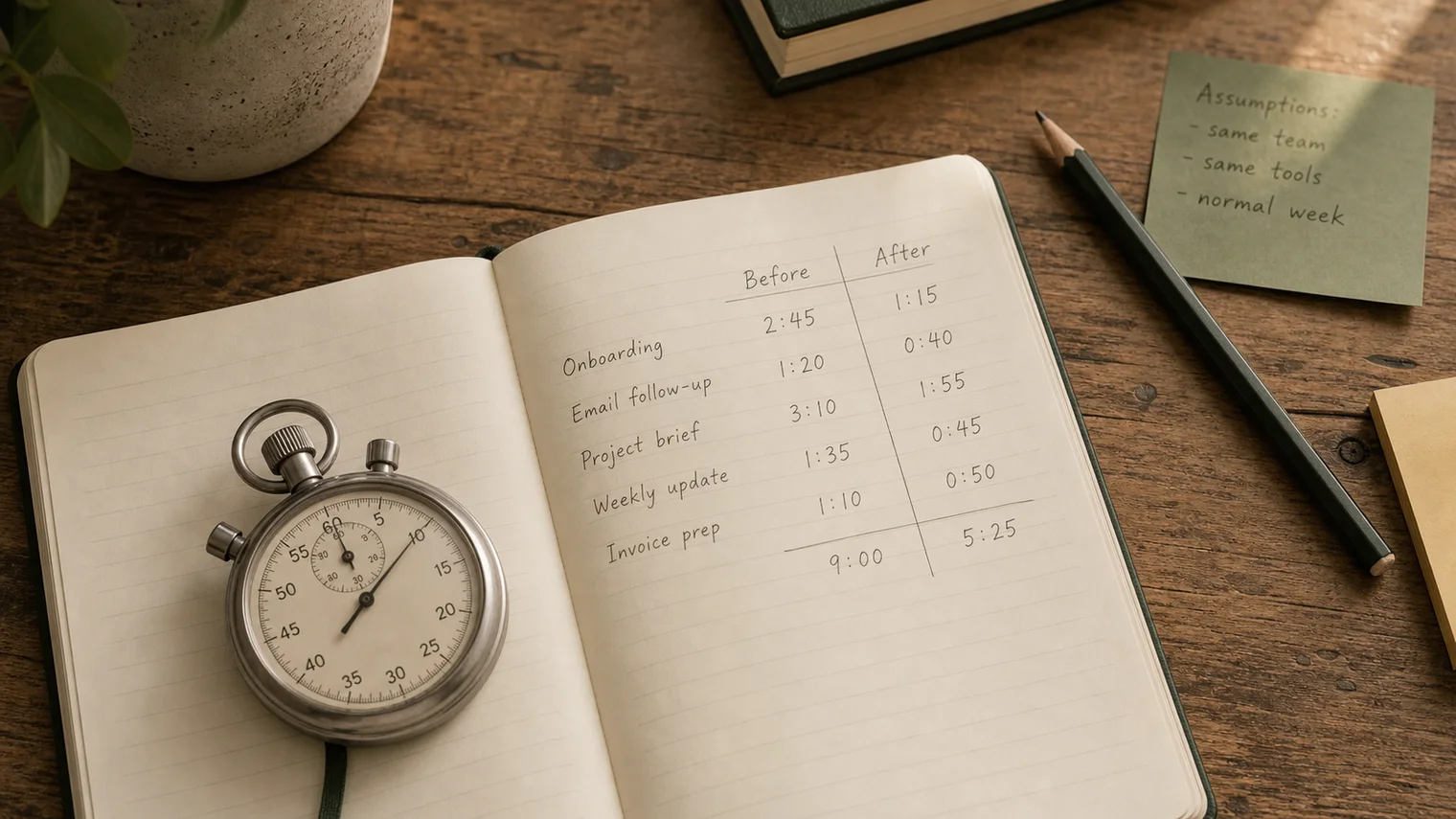
“This saves us about ten hours a week.” It’s the most common claim made about any new tool, and one of the least trustworthy. Hours saved is the easiest number to inflate — it’s usually a guess, made by the person who wants it to be true, measured against a “before” nobody actually wrote down. It’s also the hardest number to defend when someone who controls the budget asks where it came from.
That’s a shame, because time saved is genuinely the right thing to measure. AI’s whole promise to a small business is hours back every week. You just have to count them in a way you’d stand behind in front of your CFO. Here’s how to do that without fooling yourself.
Why the honest number is usually smaller
Most time-saved figures are inflated for a few predictable reasons, and naming them is half the cure.
The before is remembered, not measured — and memory rounds up, especially for tasks we dislike. The after ignores the new work the tool creates: the reviewing, the fixing, the occasional cleanup when it gets something wrong. And the saved time gets counted as if it vanished into pure productivity, when some of it just moved somewhere else. Put those together and the headline number is often two or three times the real one.
The real number is smaller. It’s also defensible, repeatable, and far more useful — because you can make decisions on it without worrying it’ll evaporate under scrutiny.
Measure the before — before you start
You cannot measure savings against a baseline you never recorded. This is the step everyone skips and the one that makes everything else honest.
Before you change anything, write down how the task works today. How long it actually takes — timed for a few days, not estimated from memory. How often it happens in a typical week. Who does it. You’re not aiming for laboratory precision; you’re aiming for a real figure you wrote down before you had a stake in the outcome. That last part matters. A baseline recorded after you’ve fallen in love with the new tool isn’t a baseline — it’s a justification.
Count the new work, not just the old
Here’s the discipline that separates an honest number from a flattering one: measure the whole new way, including the parts that aren’t free.
A new AI workflow rarely replaces a task outright. It changes its shape. The drafting gets faster, but now someone reviews and edits the draft. The sorting is instant, but someone handles the items it flagged as uncertain. The report generates itself, but someone sanity-checks it before it goes out. That review time is real, it’s part of the new process, and if you leave it out, your savings are fiction.
So time the new way end to end — including the human-in-the-loop steps — and compare that total against your baseline. The gap between the two is your real saving. It’ll be smaller than the brochure promised and larger than zero, which is exactly the kind of number you can build on.
”Saved” only counts if it goes somewhere
The last trap is subtle. Say you free up five honest hours a week. Whether that’s worth anything depends on what those hours become.
If they go into higher-value work — more customers served, faster quotes, a project that was always getting pushed — the saving is real and you can point to where it went. If they just diffuse into a slightly more relaxed week, that has value too, but it’s not the same claim, and you shouldn’t report it as if it were money in the bank. Be honest about which kind of saving you’ve got. The strongest version of the number is the one where you can name what the freed-up time is now doing.
Report a number you’d defend
Put it together and you get a claim that survives contact with a skeptic:
The task took X hours a week, measured before we started. The new way — including review and fixes — takes Y. That’s X minus Y hours back each week, and we’ve moved them into [the specific thing]. Here’s the baseline we recorded.
That’s not as punchy as “AI saved us ten hours a week.” It’s far more powerful, because every part of it holds up. You measured the before. You counted the new work. You know where the time went. Nobody can poke a hole in it, because you already poked the holes yourself.
This is also the discipline that tells you the truth about your own decisions. Measure honestly and some projects will turn out to save less than you hoped — and that’s worth knowing early, while it’s cheap to change course. Others will quietly beat expectations, and you’ll have the receipts to justify doing more. Either way, you’re deciding on evidence instead of enthusiasm.
The goal was never a big number. It was a true one. A true number, reported plainly, is what earns the trust to keep going — and trust, measured and re-earned, is how a handful of small wins turns into a business that actually runs on them.
PineyWoods ties every project to a number you already track and helps you measure it honestly — the before, the after, and where the saved time went. Want savings you can actually defend? Book a free call. Thirty minutes, a straight number, useful either way.
Put this into practice with 12 Hours a Week
A plain-English guide to finding the small, repetitive tasks eating your team's week, and what it takes to get the time back.
Get the field guide